The lost game
returns.
The most played banking game in the world for two hundred years. Then it vanished.
Two cards decide it.

-
Put a chip on a rank
Any one of the thirteen, ace to king. That is the whole bet.
-
The first card loses
It comes out of the box face up. A chip on that rank belongs to the house.
-
The second card wins
Match it and you are paid even money. Ten pounds returns a clean twenty.
-
Neither one yours
Then nothing happens and the chip stays where it is. That is four turns in five, and it is what makes faro a game you sit in rather than one you spend.
Or take the other side.
Hold a rank you have bet on and the wager turns copper. The same turn, the opposite side: now the first card out is the one that pays you.
It costs nothing to do it. The two single-card cases are equally likely, which is why faro is so close to a fair game, and why copper is a free choice rather than a priced one.
Standard. The second card pays. Coppered. The first card pays.
One deck, in public
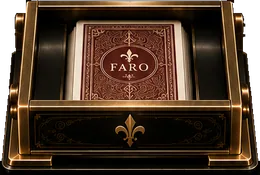
Nothing is hidden in the box.
In a real faro house the case-keeper worked a wooden frame by hand, one bead for every card, so that everybody at the table could see what was left. It is the game's one piece of public information and the reason faro rewards paying attention.
Casekeeper
Knowing what is left does not make a wager safe. It only means nobody can pretend otherwise.
The one turn the house takes on.
Both cards the same rank is a double draw. A quarter of the stake comes back, and it happens to about one wager in twenty-seven.
That is the entire edge, and it is deliberate. There is no commission on a win, so ten pounds pays a clean twenty rather than nineteen pounds eighty. Baccarat spent thirty years arriving at the same answer: take nothing from the ordinary win, and take it back on one rare named event instead.
Take a turn.
The whole game, running here. Play money, a live shoe and the same table an operator would run.
Open the table in its own window if you would rather have the whole screen.
Published, not implied
The arithmetic, in the open.
A chip sits on the table for five and a half turns before anything happens to it. So a return quoted per turn and a return quoted per wager describe the same money at two different speeds, and FARO publishes both.
Returned per wager resolved
The figure to plan against. It counts a chip once, when it is funded, and follows it to the turn that settles it.
Returned per turn
The same money, divided by every turn a chip sits through.
The house
Between single-zero roulette and three card poker, and all of it in one rare event.
Turns where nothing happens
Four in five. The chip stays, and so does the player.
Turns to a shoe
Fifty-one cards after the burn, two a turn and the box retires while seven are still in it.
These figures are provisional and theoretical. They are published for development and partner discussion, and the game itself says the same thing on its rules screen.
Two hundred years.
-
1690s
Pharaon
A French court game named for the king said to be printed on the cards. It crosses the Channel, loses a syllable and becomes faro.
-
1800s
The bank everyone played
Faster than poker and easier than whist, faro takes over American gambling houses. The case-keeper's frame sits at the end of every table.
-
1950s
Gone
A game with almost no house edge cannot survive a rising rent. The tables are replaced by ones that pay for themselves, and faro leaves the floor.
-
2026
FARO
One deck, one thumb and the casekeeper back where it belongs. The shape that made it the most played game in the world turns out to fit a phone.
For operators
Built to be handed over.
FARO is an instant game with no server of its own to install and no assumptions about where it is served from.
Embeds anywhere
Every asset path is relative by construction, so the build drops into an iframe at any path on any host without a rewrite.
Your server, one file
An authoritative shoe, ledger and round log run in the browser behind the same seam a real server sits behind. Swapping them is one module.
A phone first
Portrait, one thumb, forty-four pixel targets and a card that never shrinks to make room for a control.
Honest about the maths
The maths is provisional and the game says so itself, on the rules screen.
FARO is a game of chance
Every turn is decided by the shoe, and no run of past turns changes what the next one does. The casekeeper shows what is left in the box, and attention is rewarded, but the house still keeps a small edge on every wager.
Deposit limits, time outs and self-exclusion are held by the operator you play with. If gambling is affecting you or somebody close to you, BeGambleAware and GamCare will talk to you, free, at any hour.